
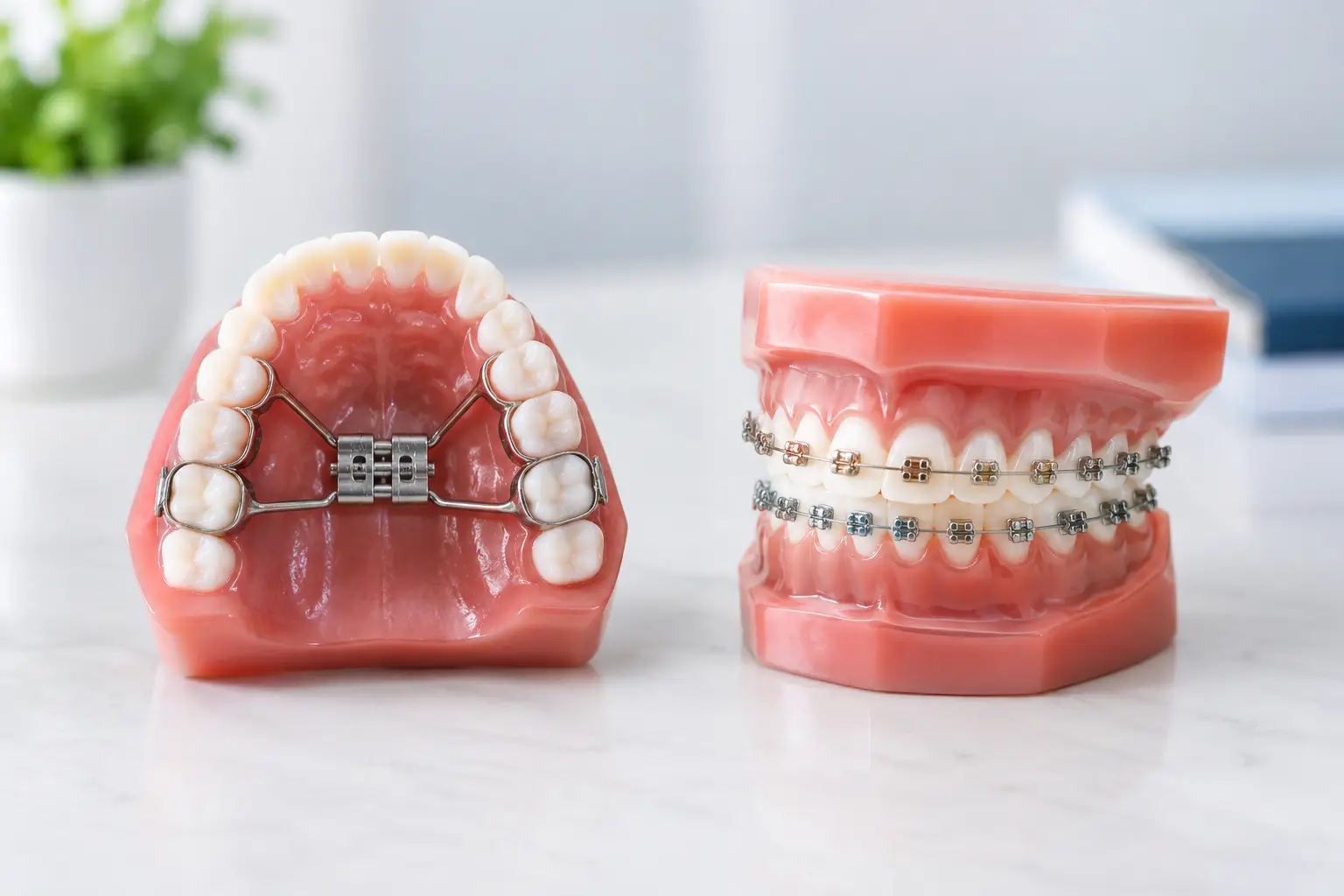
A child can have teeth that look crowded for one simple reason: there is not enough room across the upper jaw. In that situation, the question is not always whether to choose a palatal expander versus braces. Often, the better question is which treatment should happen first and what problem needs to be corrected.
Palatal expanders and braces do different jobs. An expander can create more space by widening the upper jaw in the right patient, while braces move individual teeth into healthier, more precise positions. For many children and teens, these treatments work as part of one thoughtful plan rather than as competing options.
Palatal Expander Versus Braces: The Core Difference
A palatal expander is an orthodontic appliance designed to widen the upper dental arch and, in growing patients, guide the upper jaw to develop more broadly. It is commonly attached to the upper back teeth and may include a small screw that is turned according to the orthodontist’s instructions. The pressure is gradual and controlled.
Braces use brackets and wires to move teeth. They can straighten crowded or rotated teeth, close or manage spaces, improve the way the upper and lower teeth fit together, and refine the final smile. Clear aligners can accomplish many of these same tooth-movement goals for appropriate patients.
The distinction matters because braces cannot reliably widen a narrow upper jaw in the same way an expander can during growth. Braces can tip teeth outward to a degree, but tooth position and jaw width are not the same thing. When a child has a true skeletal width concern, creating room first may support a healthier bite and a more stable result.
When a Palatal Expander May Be Recommended
Expansion is most often considered for children whose jaws are still developing. The upper jaw has a growth site at the palate that is more responsive earlier in life. This is one reason orthodontic evaluations are often recommended around age 7, even if treatment is not needed right away.
An orthodontist may consider an expander when a patient has a narrow upper jaw, a crossbite, significant crowding, or a bite that shifts to one side when closing. Some children also have difficulty with eruption because permanent teeth do not have enough space to come in comfortably. Expanding the upper arch may help create room and improve the relationship between the upper and lower jaws.
A visible gap between the upper front teeth can appear during active expansion. For parents, that can be surprising, but it is often a temporary and expected sign that the appliance is doing its job. The gap typically closes naturally over time or is addressed during later orthodontic treatment.
Not every crowded smile needs an expander. Crowding can come from tooth size, tooth position, early tooth loss, or other bite concerns. Digital imaging, photographs, scans, and a careful exam help determine whether the issue is jaw width, tooth alignment, or a combination of both.
What Expansion Feels Like
Most patients describe a feeling of pressure across the teeth or around the nose for a short time after an adjustment. It is usually not sharp pain, and the sensation often fades quickly. Speech may sound different for several days, and food can get caught around the appliance until a patient gets used to cleaning it.
The adjustment period is real, especially for younger children, but it is manageable with clear instructions and support. A soft diet for the first few days, consistent brushing, and a water flosser or orthodontic cleaning tools can make daily care much easier.
When Braces Are the Better Starting Point
Braces may be the first treatment when the jaw width is appropriate but the teeth need alignment. For example, a teen may have rotated front teeth, spacing, an overbite, an underbite, or crowding that can be corrected through controlled tooth movement without widening the palate.
Braces are also commonly used after an expander. Once enough room has been created and the upper jaw relationship has improved, braces can guide each tooth into its ideal position. This finishing phase is what creates the detailed alignment people associate with a confident, balanced smile.
For some patients, clear aligners may be an option instead of braces during this phase. The best choice depends on the bite, the movements needed, oral hygiene habits, and how reliably the patient can wear aligners as directed. There is no one-size-fits-all appliance, and a treatment plan should fit both the clinical needs and the patient’s daily life.
Can a Patient Need Both an Expander and Braces?
Yes, and this is common. Think of expansion as creating the foundation and braces as arranging the teeth on that foundation. An expander addresses width and space. Braces address alignment, bite fit, and finishing details.
A typical sequence for a growing child may involve expansion first, a period of retention while the change stabilizes, and braces later when more permanent teeth have erupted. In other cases, treatment may begin with limited braces and an expander at the same time. Timing depends on growth, tooth development, the severity of the bite concern, and the goals of treatment.
Early treatment does not always eliminate the need for braces later. Its purpose is often to address a developing problem at the time when growth can be used to the patient’s advantage. That can make later treatment simpler, more predictable, or less invasive, but every child responds differently.
What About Adults With a Narrow Upper Jaw?
Adults can absolutely improve their smiles and bites with orthodontics, but the approach to expansion is different after jaw growth is complete. A traditional palatal expander is most effective in younger patients because the upper jaw is still developing.
Depending on the adult patient’s anatomy and treatment goals, an orthodontist may discuss tooth-supported expansion, mini-screw assisted expansion, or coordinated care with another dental specialist. Braces or aligners may still be the primary treatment when the needed changes are dental rather than skeletal. A detailed evaluation is especially important because pushing teeth beyond healthy limits can affect gum health and long-term stability.
The right answer is not automatically more treatment. It is the treatment that safely supports the bite, the bone, the gums, and the patient’s goals.
How Long Does Treatment Take?
Active expansion may take only a few weeks, though the appliance usually stays in place longer so the tissues can stabilize. Braces treatment commonly ranges from about 12 to 24 months, but timing varies widely based on the complexity of the bite, the amount of movement needed, growth, and consistent care.
Retainers matter after either type of treatment. Teeth naturally have a tendency to shift over time, and retainers help protect the progress made. If an expander has been used, holding the new width is also an important part of the treatment process.
Families often want a precise timeline at the first visit, and a good orthodontic team should provide clear expectations. Still, treatment is not a race. Careful timing and regular monitoring help protect both comfort and results.
Choosing the Right Plan for Your Family
The decision between an expander, braces, clear aligners, or a combination should come after an orthodontic exam, not from comparing appliances alone. The same amount of crowding can have very different causes in two patients. Looking at jaw growth, bite function, facial balance, tooth development, and oral health gives the full picture.
At 1st Impressions Orthodontics, personalized planning means explaining what we see, why we recommend a particular approach, and what daily life with treatment will look like. Families deserve clear guidance, whether their child needs treatment now, should be monitored as they grow, or is ready to begin.
A palatal expander is not “braces before braces,” and braces are not a substitute for every width concern. Each has a specific role. The most reassuring next step is a professional evaluation that turns a confusing choice into a clear, comfortable plan for a healthier bite and a smile your family can feel good about.