
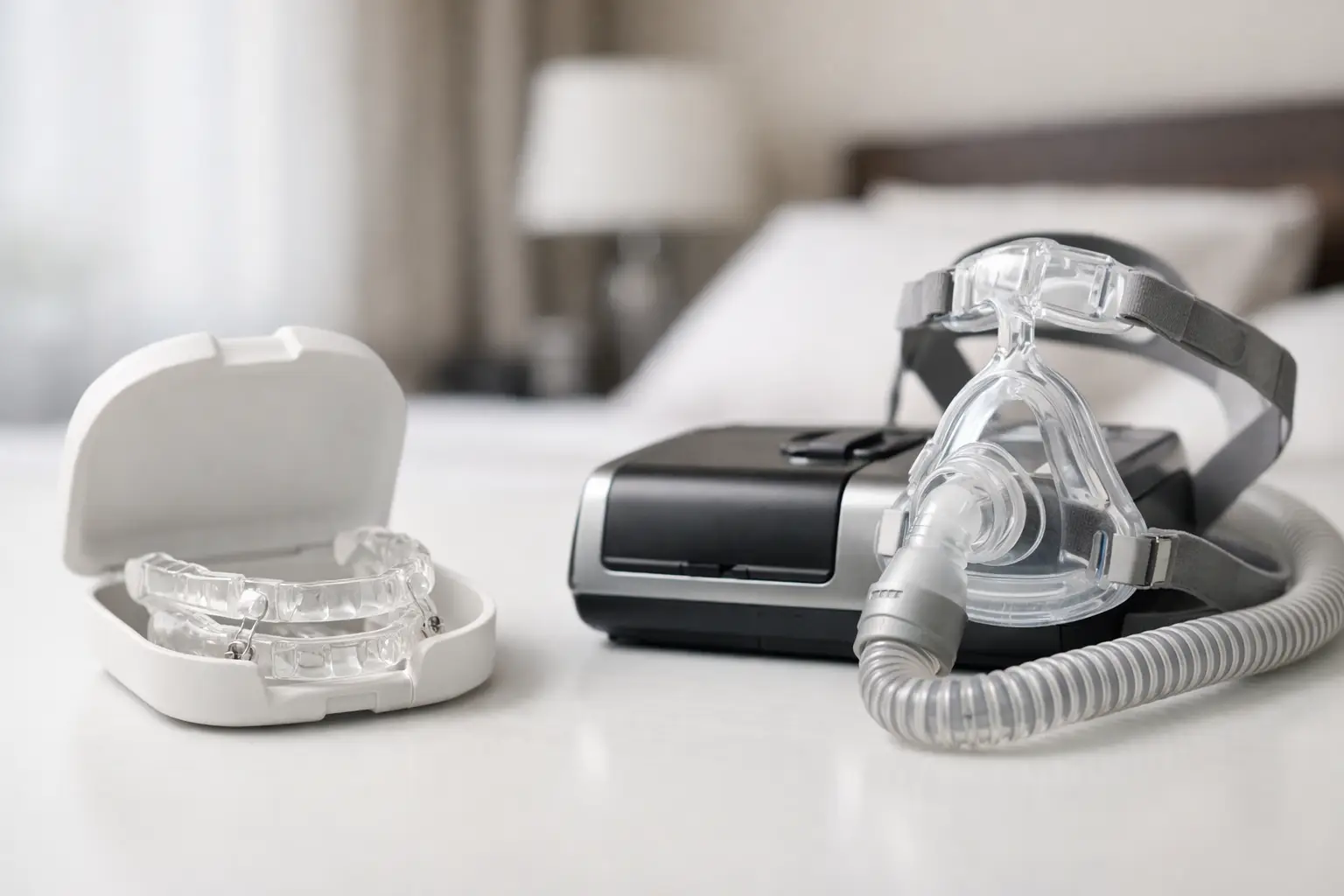
If you have been told you need treatment for obstructive sleep apnea, the question usually gets personal fast. Not theoretical – personal. Can you actually sleep with it? Will it fit your routine? Will you keep using it six months from now? When people compare sleep apnea appliance vs CPAP, they are usually trying to balance medical effectiveness with real-life comfort.
That balance matters more than many people expect. The best treatment is not just the one that works in a sleep study. It is the one you can use consistently, night after night, without feeling like bedtime has become a burden. For some patients, that means CPAP is clearly the right answer. For others, a custom oral appliance can be a more practical and sustainable fit.
Sleep apnea appliance vs CPAP: what is the difference?
A CPAP machine treats obstructive sleep apnea by delivering a steady flow of air through a mask. That airflow helps keep the airway open during sleep so breathing interruptions are reduced or prevented. CPAP is often considered the standard treatment because it can be highly effective, especially in moderate to severe cases.
A sleep apnea oral appliance works differently. It is a custom device, worn in the mouth like a retainer or mouth guard, that gently repositions the jaw or tongue to help keep the airway open. It does not use electricity, tubing, or forced air. For patients who struggle with the feel of a mask or the noise of a machine, that difference can be significant.
Both options are designed to improve sleep quality, reduce snoring, and lower the health risks associated with untreated sleep apnea. But the experience of wearing them is very different, and that is often what drives the decision.
When CPAP is the better choice
CPAP has a strong clinical track record for a reason. When it is used properly, it can be very effective at controlling breathing interruptions. For people with more severe obstructive sleep apnea, low oxygen levels during sleep, or certain medical complexities, CPAP may offer the best level of support.
It is also often the first treatment recommended after a sleep study. That does not mean it is automatically the best fit for every person. It means it is a proven option with broad medical acceptance.
The challenge is adherence. Some people do very well with CPAP from the start. Others have a harder time adjusting to the mask, air pressure, skin irritation, dry mouth, or the feeling of being connected to equipment at night. If a patient removes the mask after a couple of hours or stops using the machine regularly, the theoretical benefit starts to fall apart.
That is one of the most important trade-offs in this conversation. A treatment can be highly effective on paper and still be difficult in daily life.
When a sleep apnea appliance may make more sense
A custom oral appliance is often a good option for patients with mild to moderate obstructive sleep apnea, or for people who have tried CPAP and simply cannot tolerate it. It can also appeal to adults who travel often, share a room with a light sleeper, or want a treatment that feels less intrusive.
Because the appliance is compact and custom-made, many patients find it easier to use consistently. There is no machine to plug in, no mask to adjust, and no hose to manage. For someone balancing work, family, and a full schedule, simplicity can make a real difference.
That said, oral appliance therapy is not one-size-fits-all. The appliance needs to be designed precisely, fitted carefully, and monitored over time. Bite changes, jaw soreness, or tooth discomfort can happen if the device is poorly made or not adjusted appropriately. This is where specialized care matters.
Comfort matters more than people think
Patients sometimes feel pressure to choose whichever treatment sounds most medically serious. But comfort is not a small issue. It is central to whether treatment will become part of your normal life.
CPAP comfort issues usually involve the mask, the air pressure, or the physical setup around the bed. Some patients get used to these details quickly. Others remain aware of them every night.
With a sleep apnea appliance, comfort concerns tend to center on jaw position, tooth pressure, and fit. A custom appliance should feel secure and manageable, not bulky or painful. There may be an adjustment period, but it should not feel like a constant struggle.
In a practical sense, the better option is often the one you can wear through the night without resentment. That may sound simple, but it is one of the strongest predictors of long-term success.
Sleep apnea appliance vs CPAP for lifestyle and convenience
This is where the difference becomes especially clear for many adults. CPAP requires equipment, cleaning, replacement parts, and access to power. That may not be a problem at home, but it can become less convenient during travel, camping, overnight work trips, or late nights away from home.
An oral appliance is easier to carry and easier to store. It slips into a case and travels with you. For some patients, that convenience means they are far more likely to stay consistent with treatment.
There is also the relationship factor. Some people do not mind wearing a CPAP mask around a partner. Others feel self-conscious, especially early on. An oral appliance is less visible and usually quieter, which can make bedtime feel more normal.
None of this means convenience should outweigh medical need. It means treatment has to work in the context of your actual life, not an idealized version of it.
Effectiveness is not just about the device
It is tempting to ask which option works better as if there were one universal winner. In reality, the answer depends on your diagnosis, airway anatomy, symptom severity, and ability to stick with treatment.
CPAP often provides stronger control of apnea events, especially in more severe cases. But if someone cannot tolerate CPAP and stops using it, that effectiveness becomes irrelevant. A properly fitted oral appliance may offer better real-world results for a patient who will wear it reliably.
This is why follow-up matters. Whichever option you choose, treatment should not end the day you receive the device. You need evaluation, adjustment, and confirmation that your therapy is doing what it is supposed to do.
Why custom fitting is so important
A sleep apnea oral appliance is not an over-the-counter mouth guard. It should be custom-made based on your bite, jaw position, and treatment needs. Precision matters because small changes in jaw position can affect comfort, airway support, and long-term dental health.
That is one reason many patients prefer working with a provider who understands both airway concerns and the way the teeth and bite function together. If an appliance is going to move the jaw night after night, it should be designed with careful attention to fit and monitoring.
At 1st Impressions Orthodontics, this kind of treatment planning is centered on comfort, precision, and clear guidance, which can make the process feel much less overwhelming for patients who are new to sleep apnea treatment.
Questions to ask before choosing
A good decision usually starts with better questions. Instead of asking only which treatment is best, ask which treatment fits your diagnosis, your habits, and your tolerance.
Ask whether your sleep apnea is mild, moderate, or severe. Ask how likely you are to use CPAP consistently if you already dislike the idea of a mask. Ask whether jaw position, bite alignment, or TMJ symptoms could affect oral appliance comfort. Ask what kind of follow-up will be needed.
Most importantly, ask what happens if your first option does not work for you. Treatment should feel adaptable, not all-or-nothing.
The right choice is often individual
For some patients, CPAP is clearly the safest and most effective route. For others, a custom oral appliance offers the best balance of comfort, portability, and long-term use. Neither option is automatically right just because it works well for someone else.
What matters is finding a treatment you can trust and live with. Better sleep is not only about breathing through the night. It is about waking up feeling more rested, protecting your health, and choosing a solution that feels realistic enough to keep using long after the first week.